
📋 Table of Contents
- Introduction
- Why Choosing the Right Urologist Matters
- What Are Kidney Stones?
- How Do Kidney Stones Form?
- Types of Kidney Stones
- Symptoms of Kidney Stones
- Causes and Risk Factors
- When Should You Consult a Urologist?
- Diagnosis of Kidney Stones at Tara Hospitals
- Advanced Kidney Stone Treatment in Tirupati
- Conservative Treatment
- Laser Kidney Stone Treatment
- Retrograde Intrarenal Surgery (RIRS)
- Ureteroscopic Laser Lithotripsy (URSL)
- Percutaneous Nephrolithotomy (PCNL)
- Why Choose Tara Hospitals for Kidney Stone Treatment in Tirupati?
- Recovery After Kidney Stone Treatment
- How to Prevent Kidney Stones
- Frequently Asked Questions
- Conclusion
- Call to Action
1. Introduction
Kidney stones are one of the most painful and distressing urological conditions affecting millions of individuals worldwide. In Tirupati, with its warm climatic conditions and high prevalence of dehydration-induced renal issues, kidney stones have become increasingly common across all age groups. Fortunately, advancements in modern endourology and laser technology have transformed kidney stone management from traditional, invasive open surgeries into painless, single-day laser procedures. At Tara Multispeciality Hospital, led by renowned specialist Dr. Kasi Viswanath Gali, patients receive world-class, comprehensive kidney stone diagnosis and treatment tailored to their specific clinical needs.
2. Why Choosing the Right Urologist Matters
Selecting an experienced, highly qualified urologist is crucial for achieving complete stone clearance and safeguarding long-term renal function. A specialized urologist accurately evaluates stone size, density (Hounsfield units), shape, and precise anatomical position before recommending medical, conservative, or laser-based therapy. Under the expert care of Dr. Kasi Viswanath Gali (Consultant Urologist, Andrologist & Laser Surgeon, Gold Medalist – KMC, Manipal), patients at Tara Hospitals benefit from cutting-edge laser technologies like Thulium laser stone dusting, ensuring maximum clearance with minimal discomfort and zero open incisions.
3. What Are Kidney Stones?
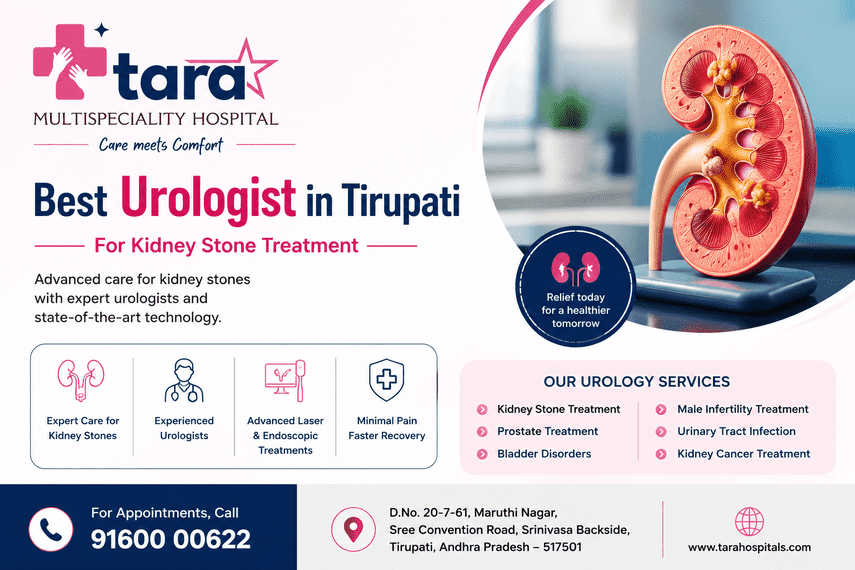
Kidney stones (nephrolithiasis) are hard, crystal-like mineral deposits that form inside the renal pelvis and calyces when urine becomes concentrated with dissolved salts. These mineral structures range from microscopic gravel to large staghorn calculi filling the entire renal collecting system. While tiny stones may remain silent inside the kidney, larger stones migrating into the narrow ureter can block urine outflow, causing acute flank pain, swelling of the kidney (hydronephrosis), and severe urinary tract infections.
4. How Do Kidney Stones Form?
The formation of kidney stones is a step-by-step chemical crystallization process known as urolithiasis. Under healthy physiological conditions, urine contains natural inhibitors like citrate, magnesium, and pyrophosphate that prevent crystal aggregation. However, when urinary volume decreases or concentration of stone-forming salts (calcium, oxalate, uric acid, phosphate) spikes, supersaturation occurs. Crystals nucleate, adhere to the renal papillary epithelium (Randall's plaques), and progressively grow into solid stones over time.
5. Types of Kidney Stones
Identifying the chemical structure of kidney stones is essential for deciding effective laser treatment and preventing future recurrences:
- Calcium Oxalate & Calcium Phosphate Stones: The most frequent stone type (accounting for ~80% of clinical cases), closely tied to insufficient water intake, high dietary oxalate, or metabolic calcium imbalance.
- Uric Acid Stones: Formed in urine that is persistently acidic, often seen in individuals with high animal protein consumption, gout, or metabolic syndrome.
- Struvite Stones (Infection Stones): Rapidly growing, complex stones that form in response to chronic urinary tract infections caused by urease-producing bacteria.
- Cystine Stones: A rare hereditary type caused by a genetic transport disorder (cystinuria) leading to high urinary excretion of the amino acid cystine.
6. Symptoms of Kidney Stones
Kidney stone symptoms often begin abruptly when a stone shifts inside the kidney or lodges in the narrow ureteral passage:
- Sharp, severe pain in the back and side beneath the ribcage (renal colic)
- Pain radiating downward to the lower abdomen, groin, and inner thigh
- Pain that comes in intense waves and fluctuates in severity
- Painful or burning sensation during urination (dysuria)
- Pink, red, or brownish urine caused by microscopic bleeding (hematuria)
- Persistent urinary urgency or frequent urination in small amounts
- Cloudy, foul-smelling urine indicating secondary infection
- Nausea, vomiting, and high fever accompanied by chills if severe infection is present
7. Causes and Risk Factors
Understanding underlying risk factors helps patients take proactive steps toward prevention:
- Inadequate Daily Fluid Intake: Drinking less than 2.5 to 3 liters of water daily, particularly during Tirupati's hot summer months.
- Dietary Factors: Excess sodium (salt), high animal protein intake, and foods rich in oxalates (spinach, nuts, cocoa).
- Family or Personal History: Individuals with a family history of urolithiasis have a significantly higher risk.
- Obesity & High BMI: Alters urinary pH and electrolyte balance, increasing stone-forming potential.
- Medical Conditions & Medications: Hyperparathyroidism, inflammatory bowel disease, chronic diarrhea, and excessive use of certain calcium or antacid supplements.
8. When Should You Consult a Urologist?
Prompt urological evaluation is critical if you experience agonizing flank pain, visible blood in urine, difficulty urinating, or fever with chills. Delaying medical care can lead to serious complications such as permanent renal damage, severe kidney infection (pyelonephritis), or urinary sepsis. For general systemic health checks and metabolic risk assessments, consult our General Medicine department alongside specialized urology consultation.
9. Diagnosis of Kidney Stones at Tara Hospitals
At Tara Multispeciality Hospital, state-of-the-art diagnostic imaging and lab testing are utilized for accurate treatment planning:
- Non-Contrast CT KUB (NCCT): The absolute gold standard imaging tool for determining exact stone size, location, stone density (Hounsfield units), and anatomical obstruction.
- Ultrasound KUB: A quick, non-invasive imaging method ideal for identifying kidney swelling (hydronephrosis) and urinary bladder stones.
- Urine Routine & Microscopic Examination: Identifies red blood cells, pus cells, infection markers, and crystal types.
- Kidney Function Tests (KFT): Measures Serum Creatinine and Blood Urea levels to evaluate underlying renal health prior to procedure.
10. Advanced Kidney Stone Treatment in Tirupati
Tara Hospitals provides comprehensive, evidence-based kidney stone treatment options ranging from medical management to advanced endoscopic laser lithotripsy. Every treatment plan is individualized to deliver high stone clearance with minimum hospital stay.
11. Conservative Treatment
Small kidney stones (typically under 5mm in size) without severe blockage or infection can often pass naturally with conservative measures:
- Medical Expulsive Therapy (MET): Prescription of selective alpha-blockers to relax ureteral smooth muscles, facilitating painless natural stone expulsion.
- High Fluid Intake: Drinking 3 to 4 liters of water daily to maintain high urine volume.
- Targeted Analgesics: Prescribed anti-inflammatory pain medications for comfort during stone passage.
12. Laser Kidney Stone Treatment
For stones larger than 6mm or those causing severe blockage, advanced laser lithotripsy is the procedure of choice. Utilizing high-frequency Thulium laser fibers, energy is directed precisely at the stone, vaporizing it into ultra-fine dust particles that wash out naturally in urine with zero external incisions.
13. Retrograde Intrarenal Surgery (RIRS)
RIRS is the most advanced, non-invasive technique for treating stones inside the kidney (up to 2cm). A highly flexible ureteroscope is passed through the natural urinary passage directly into the kidney. The Thulium laser fiber is used to dust the stone. RIRS requires zero incisions, causes negligible pain, and allows patients to return home within 24 hours.
14. Ureteroscopic Laser Lithotripsy (URSL)
URSL is ideal for stones lodged in the ureter. A semi-rigid ureteroscope is passed through the natural opening to visualize the stone, fragment it with laser energy, and extract the pieces using stone retrieval baskets. Patients achieve immediate pain relief and fast discharge.
15. Percutaneous Nephrolithotomy (PCNL)
For large, complex, or staghorn kidney stones (greater than 2cm), PCNL remains the gold standard. A tiny keyhole entry (approx. 1 cm) is created in the back to directly access the renal pelvis. The stone is fragmented using laser or pneumatic lithotripters and completely evacuated, achieving complete clearance in a single sitting.
Looking for the Best Urologist in Tirupati for Kidney Stone Treatment?
Tara Hospitals offers advanced diagnosis, laser kidney stone treatment and personalized urology care in Tirupati.
16. Why Choose Tara Hospitals for Kidney Stone Treatment in Tirupati?
Tara Multispeciality Hospital is widely recognized as the premier destination for urological care across Tirupati and Rayalaseema:
- Expert Consultant Urologist: Spearheaded by Dr. Kasi Viswanath Gali (MCh Urology Gold Medalist – KMC, Manipal), offering extensive clinical experience in endourology and laser surgery.
- World-Class Laser Equipment: Equipped with advanced Thulium laser units, flexible digital ureteroscopes, and ultra-sterile Laminar Airflow Operation Theatres.
- Complete Inpatient & ICU Support: Round-the-clock emergency medical response, modern 20-bed inpatient capacity, and fully equipped ICU backup.
- Affordable & Transparent Care: Empanelled with major insurance and TPA partners for cashless and hassle-free hospitalization. Explore our preventive Health Packages for routine kidney screenings.
17. Recovery After Kidney Stone Treatment
Recovery after laser kidney stone treatment at Tara Hospitals is fast and comfortable. Most patients are discharged within 24 hours of RIRS or URSL procedures. Patients are advised to drink plenty of fluids, complete prescribed antibiotic courses, and refrain from strenuous physical activity for a few days. A temporary double-J (DJ) stent placed to ensure smooth urine flow is painlessly removed during a brief OPD follow-up after 1 to 2 weeks.
18. How to Prevent Kidney Stones
Preventing stone recurrence requires consistent dietary and lifestyle changes recommended by global organizations like the National Kidney Foundation, American Urological Association, NIDDK, and World Health Organization:
- Maintain optimal daily hydration by drinking at least 3 liters of water throughout the day.
- Incorporate natural lemon water into your routine, as citrate inhibits crystal aggregation.
- Reduce dietary sodium (table salt) to below 2,300 mg per day.
- Consume normal levels of dietary calcium (milk, curd) while avoiding unprescribed calcium supplements.
- Limit intake of oxalate-heavy foods (spinach, beetroot, dark chocolate, nuts) if prone to calcium oxalate stones.
- Moderate animal protein consumption to keep urinary uric acid levels low.
19. Frequently Asked Questions
Q1. Who is the best urologist in Tirupati for kidney stone treatment?
Dr. Kasi Viswanath Gali (MBBS, MS, MCh Urology Gold Medalist) at Tara Multispeciality Hospital is widely recognized as a leading urologist in Tirupati specializing in advanced laser kidney stone treatment, RIRS, URSL, and PCNL.
Q2. Can kidney stones be treated without surgery?
Yes, small kidney stones (under 5mm) can often be managed conservatively using Medical Expulsive Therapy (MET), increased fluid intake, and lifestyle modifications under urological supervision.
Q3. Is laser kidney stone surgery painful?
No, laser kidney stone surgery (such as RIRS or URSL) is performed under short anesthesia without any external cuts or stitches. Post-operative pain is minimal and managed with simple medication.
Q4. How long does laser kidney stone surgery take?
Most laser kidney stone procedures take between 30 to 60 minutes depending on stone size, location, and complexity.
Q5. What is the recovery time after kidney stone surgery?
Patients undergoing RIRS or URSL laser treatment are usually discharged the same day or within 24 hours and can resume light normal activities within 2 to 3 days.
Q6. Can kidney stones come back?
Kidney stones have a 50% recurrence rate within 5 to 10 years if underlying metabolic or dietary causes are not addressed. Proper hydration and preventive dietary plans significantly reduce recurrence.
Q7. Which foods help prevent kidney stones?
Drinking plenty of water, lemon water (rich in citrate), and maintaining balanced calcium intake helps prevent stones, while reducing excess salt, animal protein, and high-oxalate foods.
Q8. When should I seek emergency care for kidney stones?
Seek emergency care immediately if you experience severe unbearable side/back pain, high fever with chills, vomiting, blood in urine, or an inability to pass urine.
20. Conclusion
Kidney stones can cause severe pain and disruption, but with advanced laser technology and expert care from Dr. Kasi Viswanath Gali at Tara Multispeciality Hospital, treatment is safe, quick, and virtually painless. If you or a loved one are experiencing symptoms of kidney stones, do not suffer in silence. Early evaluation and intervention ensure rapid relief and long-term protection for your kidneys.
Looking for the Best Urologist in Tirupati for Kidney Stone Treatment?
Tara Hospitals offers advanced diagnosis, laser kidney stone treatment and personalized urology care in Tirupati.